Uncategorized
How to Reconstitute Lyophilised Peptides
Jul
A vial that looks half empty can still contain the full stated amount of peptide. That is where plenty of handling errors start. If you are learning how to reconstitute lyophilised peptides, the goal is not just getting powder into solution – it is preserving peptide integrity, maintaining concentration accuracy, and reducing avoidable contamination.
Lyophilised peptides are freeze-dried for stability during storage and transport. Before research use, they need to be brought back into solution with an appropriate diluent, usually bacteriostatic water or, in some cases, sterile water or another solvent suited to the compound. The exact method is simple in principle, but the details matter. Poor technique can alter concentration, reduce stability, or leave you guessing at the true amount per unit volume.
How to reconstitute lyophilised peptides correctly
Start with the label and batch documentation. Confirm the peptide name, total amount in the vial, and any manufacturer handling notes. A 10 mg vial and a 5 mg vial can look identical, and assuming the wrong mass will throw every calculation off from the first step. If the supplier provides third-party HPLC and mass spectrometry data, use that documentation as part of your verification process before handling the vial.
Next, decide on the final concentration you want. This depends on your research protocol and how precise you need each measured volume to be. Reconstitution is not just adding liquid until the powder disappears. You are setting a known concentration, such as 2 mg/mL or 5 mg/mL, so every measured increment corresponds to a defined amount of peptide.
For example, if a vial contains 10 mg of lyophilised peptide and you add 2 mL of diluent, the final concentration is 5 mg/mL. If you add 4 mL instead, the concentration becomes 2.5 mg/mL. Neither is inherently right or wrong. The better choice is the one that makes measurement practical and repeatable for your research setup.
Choose the right diluent
In most peptide handling contexts, bacteriostatic water is the default because it contains a preservative that can help limit bacterial growth after first puncture. That makes it a practical option for multi-use handling. Sterile water may also be used in some protocols, but it generally offers less protection once opened and handled repeatedly.
Some peptides are more sensitive than others. Certain compounds may dissolve more effectively with a small amount of acetic acid or another specific solvent before further dilution, while others should be handled only with water-based diluents. This is where peptide-specific guidance matters. There is no universal rule that applies equally to BPC-157, TB-500, GHK-Cu, Semax, Selank, MOTS-c, and Epithalon, even if the reconstitution workflow looks broadly similar.
Prepare a clean workspace
Use a clean, stable surface with minimal airflow and minimal unnecessary handling. Wash your hands, wear gloves if appropriate for your protocol, and wipe the rubber stoppers of both the peptide vial and the diluent vial with an alcohol swab. Let the alcohol dry before puncturing. That short pause helps reduce contamination risk and avoids carrying excess alcohol into the solution.
Sterility is not just about the first puncture. It is about every step after it as well. Reusing needles carelessly, touching stopper tops, or leaving open consumables on the bench can compromise the solution even if the peptide itself started as a high-purity, third-party tested batch.
Step-by-step reconstitution method
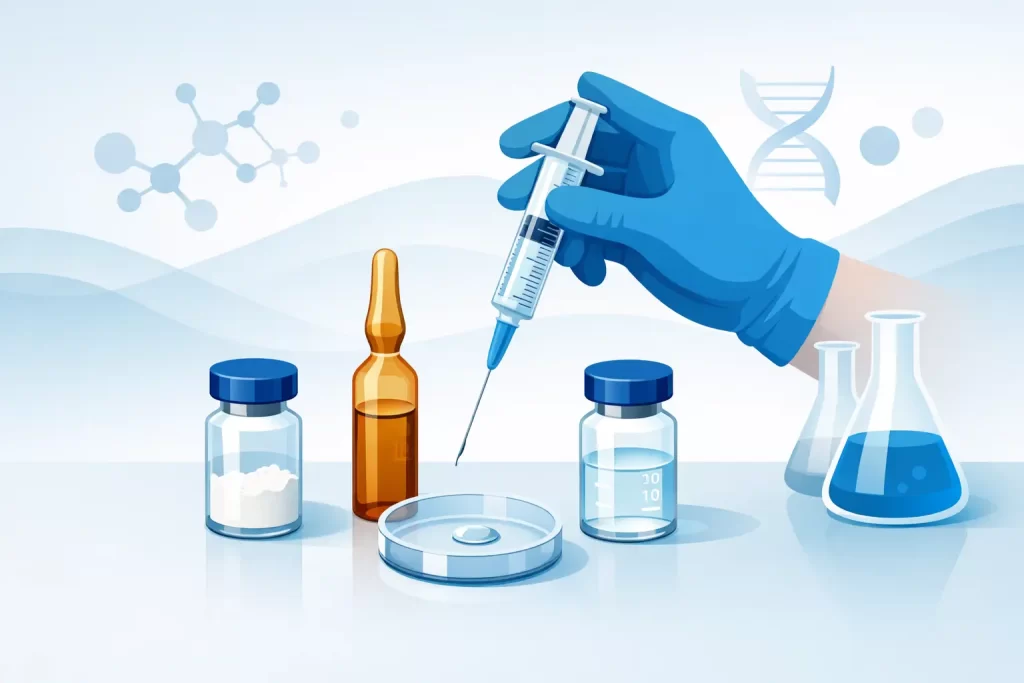
Draw the required volume of diluent into a sterile syringe. If you have decided on 2 mL, measure 2 mL accurately rather than estimating. Small volume errors make a meaningful difference when working with milligram quantities.
Insert the needle into the peptide vial and direct the stream of diluent against the inside glass wall rather than blasting it straight onto the lyophilised cake. That helps reduce foaming and mechanical stress. Some peptides are relatively forgiving, while others can be denatured by rough handling.
Once the diluent is added, do not shake the vial aggressively. Instead, gently swirl or roll it until the peptide dissolves. If the solution is slow to clear, give it time. A few minutes of patience is better than vigorous agitation that may damage the compound.
Visually inspect the solution once dissolved. It should generally appear clear, unless the peptide or solvent system is known to produce a different appearance. If you see persistent particles, cloudiness, or unusual colour change, stop and review the compound-specific handling notes and storage history.
Common concentration maths
The concentration formula is straightforward:
Concentration = total peptide amount ÷ total diluent volume
If your vial contains 5 mg and you add 1 mL, that gives 5 mg/mL. If you add 2 mL, it becomes 2.5 mg/mL. If your vial contains 10 mg and you add 5 mL, the result is 2 mg/mL.
This matters because measured volume is only useful when tied to a known concentration. Without that, accuracy is mostly guesswork. For research buyers who care about repeatability, this is one of the biggest differences between disciplined handling and sloppy bench practice.
It depends on the peptide
Not every lyophilised peptide behaves the same way after reconstitution. Some dissolve almost immediately. Others take longer. Some remain stable in solution for a reasonable period under refrigeration, while others are best used promptly after preparation.
That is why storage assumptions can be risky. A peptide with strong documentation, verified purity, and clear handling guidance is easier to work with than one sold with no batch data and no meaningful technical support. In a category where counterfeit and underdosed material remains a real issue, quality verification is not a marketing extra – it is part of the handling equation.
Storage after reconstitution
Once reconstituted, peptides are typically stored refrigerated unless compound-specific guidance says otherwise. Keep the vial protected from heat, repeated temperature fluctuation, and unnecessary light exposure. Do not leave it sitting out on the bench longer than needed.
For longer storage, some researchers aliquot the solution into smaller sterile containers to reduce repeated punctures and limit freeze-thaw cycles. Whether that is appropriate depends on the peptide, the solvent, and how often the solution will be accessed. Repeated handling increases contamination risk, so planning ahead helps.
Label the vial clearly with the peptide name, concentration, diluent used, and reconstitution date. If you are managing multiple compounds at once, this is non-negotiable. Misidentification happens faster than most people think, especially when vials share similar sizes and stopper colours.
Mistakes that cause the most problems
The most common error is getting the maths wrong. The second is using the wrong diluent. The third is rough handling during reconstitution. After that, most failures come down to contamination, poor storage, or assuming all peptides have the same stability profile.
Another frequent issue is buying material with weak traceability. If the vial content is not backed by credible purity claims, COA access, and analytical verification, precise reconstitution still cannot fix a poor starting material. Suppliers that publish third-party testing, HPLC results, and mass spectrometry data reduce that uncertainty substantially. For Australian buyers, that level of documentation matters just as much as fast domestic fulfilment and proper cold-chain handling.
When a peptide does not dissolve properly
If a peptide is not dissolving, do not keep shaking harder and hoping for the best. Check that the diluent is appropriate, confirm the vial has reached a sensible handling temperature, and allow more time for gentle swirling. Some peptides need patience more than force.
If undissolved material persists, review whether the peptide may require a different solvent approach. This is a technical issue, not a cosmetic one. Cloudiness, clumping, or residue can indicate anything from incomplete dissolution to degradation or incompatibility. Treat it as a quality-control checkpoint, not a minor annoyance.
A supplier with proper batch documentation and educational support makes this easier to troubleshoot. That is one reason serious research buyers tend to favour specialist vendors over generic sellers with thin product data and no analytical transparency. Aussie Peptide Labs positions strongly in that category by keeping quality verification visible rather than buried.
Final handling mindset
The best approach to reconstituting peptides is disciplined rather than complicated. Verify the vial, calculate the concentration before you start, use a suitable diluent, handle the solution gently, and store it with the same care you expect from the supplier that manufactured and tested it. Precision at this stage protects the value of the compound and the quality of the work that follows.
If you treat reconstitution as a technical step instead of a quick prep task, you make fewer mistakes and get cleaner, more reliable outcomes from every vial.
