Uncategorized
Does HPLC Measure Peptide Purity? What It Shows
Sep
A peptide label stating 99% purity should prompt a straightforward technical question: does HPLC measure peptide purity? Yes, high-performance liquid chromatography, usually called HPLC, is one of the main tools used to assess peptide purity. But the percentage on a chromatogram is only as meaningful as the method behind it, the detector used and the documentation supplied with the batch.
For research buyers, the practical point is simple. HPLC is highly useful for detecting and estimating peptide-related impurities, but it does not independently prove every aspect of a peptide’s quality. Identity, mass, residual solvents, water content and microbial status require their own appropriate tests. A credible Certificate of Analysis, or COA, makes clear what has actually been tested rather than treating one result as a catch-all quality claim.
Does HPLC measure peptide purity directly?
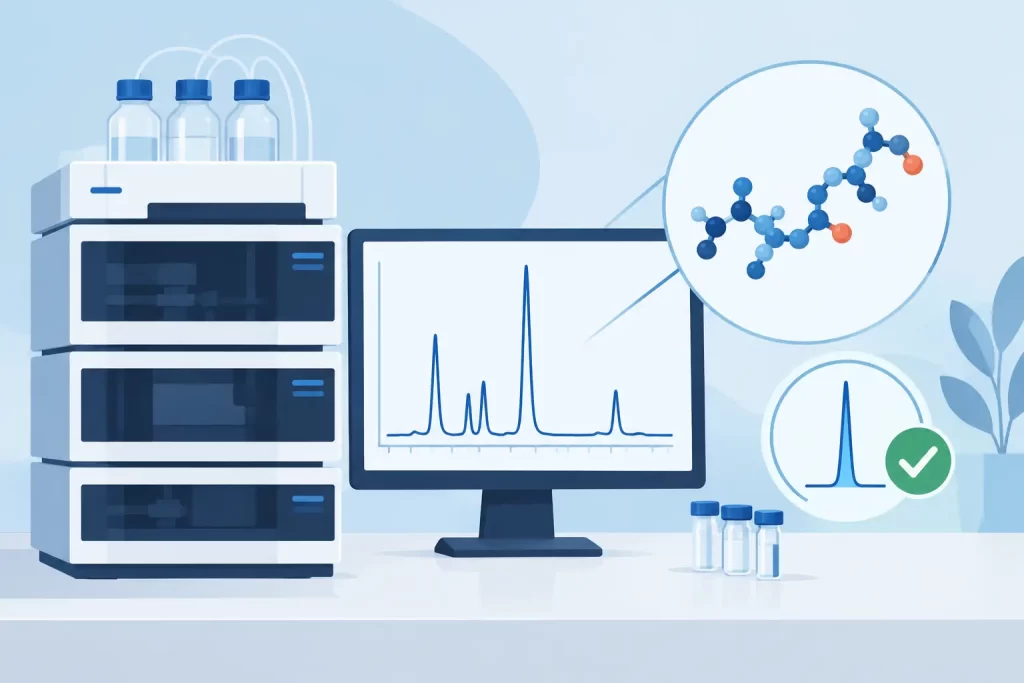
HPLC separates compounds in a sample as they pass through a packed chromatography column. Each compound interacts with the column and mobile phase differently, causing it to leave the column at a different time. The detector records these eluting components as peaks on a chromatogram.
For synthetic peptides, reversed-phase HPLC is the common approach. The sample is typically run through a C18 column using a water and organic-solvent gradient, often with an acidic modifier. The intended peptide should produce a principal peak at its expected retention time. Deletion sequences, truncated material, oxidation products, synthetic by-products and other related substances may appear as additional peaks.
The purity figure commonly reported on a peptide COA is the main peak’s area as a percentage of the total integrated peak area. If the principal peak represents 99% of the reportable chromatographic area, the result may be stated as 99% HPLC purity.
That is a useful result, but it is more precise to call it chromatographic area purity under the stated conditions. It tells you how dominant the target peak is in that particular analysis. It is not automatically an absolute measure of every non-peptide substance in the vial.
Why an HPLC purity percentage needs context
A clean-looking chromatogram is reassuring, but chromatographic area percentage has limits. UV detectors, commonly used in peptide HPLC, respond according to a compound’s absorbance at the selected wavelength. Different impurities can produce stronger or weaker signals than the target peptide. An impurity with weak UV absorbance may contribute less area than its mass proportion would suggest.
Co-elution is another consideration. If an impurity elutes at the same time as the target peptide, the method may show one apparently clean peak even though two substances are present. Well-developed methods reduce this risk through suitable column chemistry, gradient design and resolution checks, but no single HPLC run can eliminate every analytical question.
The method matters particularly for peptides because their sequence and modifications influence both retention and detection. A small sequence deletion may resolve clearly from the main peak on one method, then sit close to it on another. Oxidised methionine-containing peptides, deamidated material and some isomeric forms can also require careful method development to distinguish them reliably.
For this reason, a bare statement such as “99% purity” is less useful than a batch-specific COA showing the test method, chromatogram, result and relevant sample details. The number matters. The evidence supporting it matters just as much.
HPLC purity is not the same as peptide identity
HPLC can indicate that a sample contains one dominant chromatographic component. It cannot, by retention time alone, definitively confirm that the component has the intended molecular mass and sequence.
Mass spectrometry, usually abbreviated as MS, complements HPLC by measuring the mass-to-charge ratio of ions from the sample. For a synthetic peptide, an MS result consistent with the expected molecular mass provides strong evidence that the principal material is the intended compound. HPLC-MS combines separation with mass detection, allowing analysts to associate a chromatographic peak with an expected mass.
This is why third-party HPLC and mass spectrometry testing are valuable quality controls for research-grade peptides. HPLC addresses relative chromatographic purity. MS supports identity confirmation. Together, they provide a materially stronger basis for assessing a batch than either technique used in isolation.
Even then, testing should be matched to the question being asked. MS does not replace assays for sterility, endotoxin, residual solvents or peptide content by mass. Those are separate quality attributes and may be relevant depending on the intended research setting. Research-use-only materials must be handled and evaluated in line with appropriate laboratory procedures and are not supplied for human or veterinary use.
What a credible peptide HPLC report should show
When reviewing a COA, first confirm that it relates to the actual batch being considered. A generic sample chromatogram can demonstrate a supplier’s analytical capability, but it does not verify every subsequent production lot.
A useful HPLC record identifies the analyte and batch or lot number, then reports the purity result with a chromatogram. It should also show enough method detail to establish that the result comes from an analytical procedure rather than a marketing estimate. Relevant details commonly include the column type, mobile phases, detection wavelength, gradient or run time, retention time and date of analysis.
Look at the chromatogram itself, not solely the headline percentage. The dominant peak should be clear, while minor peaks should be visible at an appropriate scale. Extremely compressed axes can make low-level impurities difficult to assess visually. That does not invalidate a result, but it is one reason a reported value should be read alongside the analytical method and any supporting identity data.
Four practical checks help keep a COA review disciplined:
- Match the product name, batch number and test date to the material being supplied.
- Confirm whether the figure is reported as HPLC area percentage, rather than assuming it is absolute assay purity.
- Check for supporting MS identity data with an expected molecular mass consistent with the peptide.
- Assess whether the document names the testing laboratory and provides traceable analytical information.
A legitimate COA should reduce ambiguity. It will not necessarily include every proprietary method parameter, but it should provide enough batch-level evidence for a research buyer to understand the claim being made.
When 99% HPLC purity is meaningful
For many synthetic-peptide research applications, a high HPLC area percentage is a relevant and useful selection criterion. It indicates that the intended peptide is the predominant UV-detectable component under the test conditions. When paired with mass confirmation and batch documentation, it is a practical marker of manufacturing and purification quality.
However, purity requirements are not universal. Early-stage exploratory work may have different analytical requirements from quantitative assay development, reference-standard work or research where trace contaminants could materially alter a readout. The more sensitive the experiment, the more a researcher should consider additional specifications beyond headline HPLC purity.
It is also worth separating purity from quantity. A vial may contain highly pure peptide material while the net peptide content, hydration state or salt form affects the actual amount of peptide available by weight. Lyophilised peptides can contain counterions and variable moisture. If accurate concentration is central to an experiment, peptide content or assay data may be needed in addition to area purity.
Choosing evidence over a headline claim
HPLC remains a cornerstone technique because it is fast, sensitive and well suited to separating many peptide-related impurities. It is the right starting point for judging whether a peptide batch is chromatographically clean. It is not, on its own, a complete quality profile.
At Aussie Peptide Labs, the quality standard for research-grade materials is built around batch-level documentation and third-party HPLC/MS verification, not an unsupported purity label. For buyers comparing peptide suppliers, that distinction is worth carrying into every purchase decision.
The most useful habit is to treat a purity claim as a question with evidence behind it: what did the HPLC method separate, what did the detector measure, and what independent data confirms the main peak is the peptide you intended to research?
